Article Overview
Telehandlers play a critical role in modern construction and agricultural operations where safe, efficient material handling is essential. Understanding the different types of telehandlers, including how lift capacity and reach affect performance, allows contractors and farm operators to select equipment that matches real jobsite demands. This article breaks down telehandler classifications and practical applications so crews can choose the right machine for framing, truss placement, bulk material handling, and facility maintenance without oversizing or limiting productivity.
Material handling requirements vary significantly from one job to the next. A framing crew placing roof trusses has different lifting demands than a feedlot moving bulk totes or a maintenance team servicing elevated equipment. Understanding the types of telehandlers available helps contractors and agricultural operators select the right machine for safe, efficient, and cost-controlled performance.
Telehandlers are not one-size-fits-all. Capacity ratings, lift height, forward reach, and attachment compatibility all determine how well a unit performs in real jobsite conditions. Selecting the correct class prevents overloading, improves stability, and reduces unnecessary fuel and transport costs.
Before evaluating the different types of telehandlers, it is important to understand What Telehandlers Are And Why They Are Essential On Construction And Agricultural Job Sites, since capacity and reach only matter when matched to real jobsite demands.
How Are Telehandlers Classified By Capacity?
The primary way to distinguish the types of telehandlers is by rated lift capacity. Most rental fleets commonly offer machines in the 5,000 to 12,000 pound range.
A 5,000 pound telehandler is typically suited for lighter construction tasks such as moving palletized materials, lifting small framing packages, and handling agricultural inputs like seed or feed bags. These units are compact, easier to maneuver in tight areas, and often preferred for smaller residential builds or confined farmyards.
Mid-range units in the 7,000 to 9,000 pound category provide more versatility. They are commonly used for truss placement, moving larger lumber bundles, positioning mechanical equipment, and supporting multi-trade construction sites. This class often represents the best balance between reach and lifting strength for general construction projects.
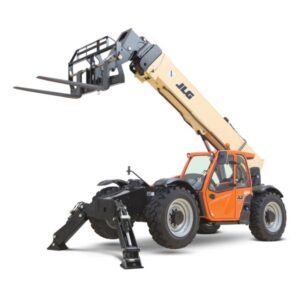
Higher-capacity 10,000 to 12,000 pound units are designed for heavier loads and longer reach requirements. These are frequently selected for commercial builds, agricultural facility construction, and industrial material handling where weight and elevation demands are greater. What sets these machines apart is the inclusion of outriggers that provide added stability when lifting heavier loads to height, which is an important distinction for maintaining safe operation and full rated capacity at extended reach.
Matching lift capacity to the heaviest anticipated load is essential. Overestimating needs increases costs, while underestimating capacity creates safety risks and productivity issues.
How Does Lift Height And Forward Reach Impact Performance?
Lift height and forward reach define how effectively materials can be placed. Lift height determines how high a load can be raised vertically, while forward reach measures how far the boom can extend outward at a given height, safely and within rated capacity based on the weight of the load.
For example, roof truss installation often requires both height and forward placement capability. A machine that reaches 40 feet vertically but lacks adequate forward reach may require constant repositioning or, in some cases, may be unable to complete the task safely with the required load. That slows production and reduces overall jobsite efficiency.
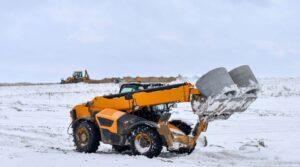
In agricultural settings, stacking large round bales or loading elevated storage bins demands sufficient vertical lift. For maintenance work inside industrial buildings, compact units with controlled reach may be more appropriate.
When evaluating the types of telehandlers, contractors should review manufacturer lift charts carefully. Lift capacity decreases as boom extension increases. Understanding this relationship ensures safe operation and proper machine selection.
What Are The Main Jobsite Applications For Different Telehandler Classes?
Each telehandler class serves specific jobsite roles. The key is aligning machine capability with project demands.
Smaller capacity telehandlers are commonly used inside industrial buildings, in material yards, and for general on-site material handling where lift height requirements are moderate and maneuverability is important. These units are well suited for moving palletized supplies, repositioning equipment, handling bulk seed totes in controlled environments, and supporting maintenance work where space is limited but lifting strength is still required.
Mid-range telehandlers are primarily used for residential framing, including roof truss placement and multi-storey structural work where greater lift height and forward reach are required. They are also well suited for moving concrete blocks, handling large round bales, and supporting general construction material handling where added lifting strength improves efficiency and stability.
Higher-capacity telehandlers are typically used for commercial construction builds, multi-storey residential projects such as custom homes and multi-family developments, and large-scale agricultural facility work where both height and lifting strength are critical. These machines are well suited to rougher terrain environments and are equipped with outriggers that provide added stability when operating at maximum reach and rated capacity. The use of outriggers is a key distinction, allowing the machine to safely extend further while maintaining proper load control. For example, when considering a 12,000 pound telehandler, review the manufacturer’s lift charts and specifications to confirm safe operating limits.
Understanding these applications helps prevent over-equipping a site or renting a machine that lacks required performance.
How Do Attachments Influence Telehandler Selection?
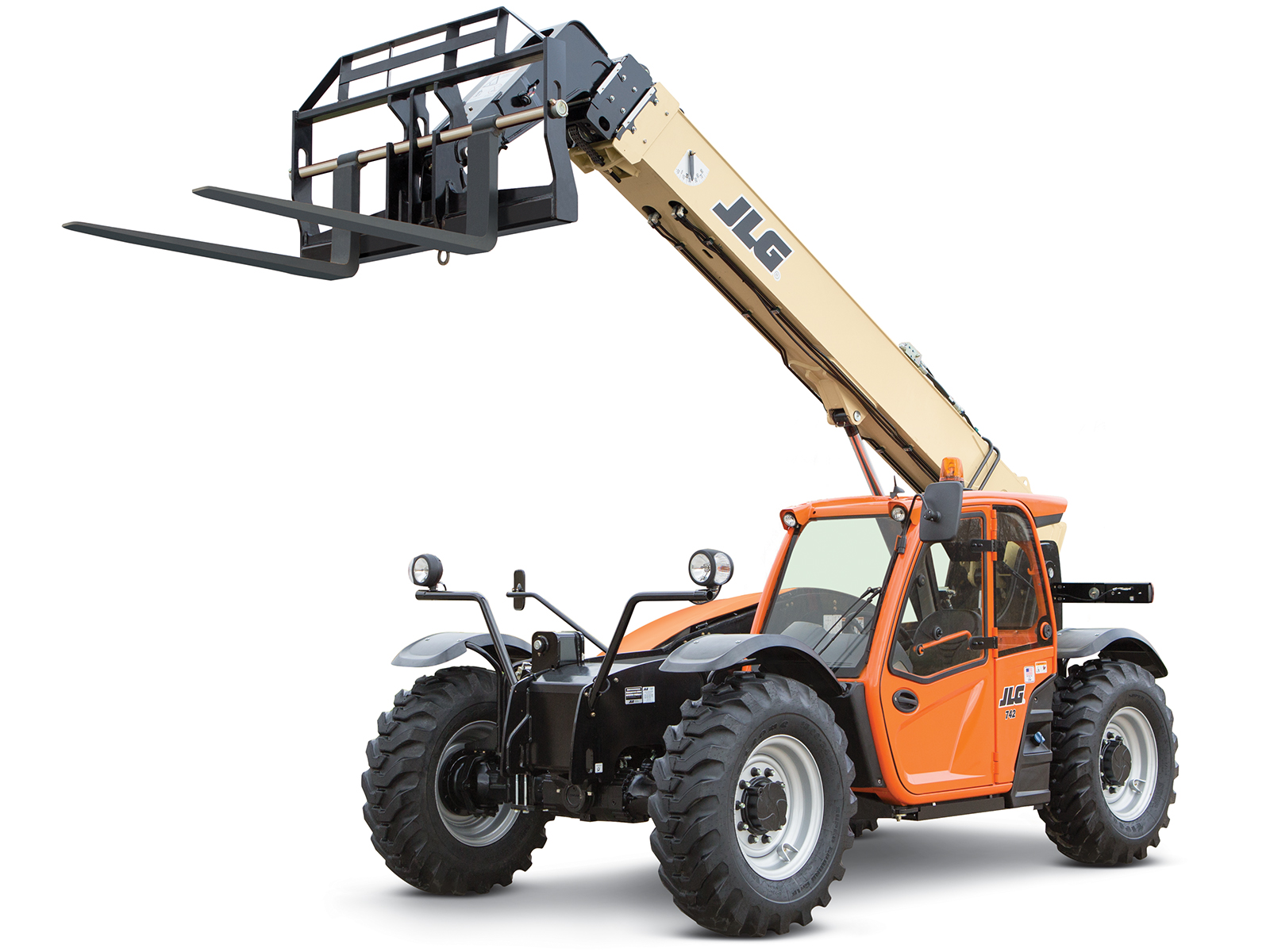
Attachments significantly expand telehandler capability. Pallet forks are the standard configuration, while common upgrades include truss jibs, approved work platforms, crane jibs equipped with a winch for heavier suspended loads, swing carriages that allow side-to-side fork movement for precise placement, and buckets for general material handling.
A truss jib attachment allows precise placement of trusses or beams during framing, with the added advantage of extending the telehandler’s reach by approximately 4 to 12 additional feet. The standard pallet forks remain the most versatile configuration for moving bulk materials. Approved work platforms, or man baskets, allow crews to safely perform elevated installation and maintenance tasks when used within rated capacity and safety guidelines.
When comparing the types of telehandlers, it is important to confirm that hydraulic capacity and structural stability match the intended attachment. Not all machines handle every attachment equally. Selecting a telehandler with compatible auxiliary hydraulics and sufficient lift stability ensures safe and efficient performance.
Why Does Terrain And Site Access Matter?
Southern Alberta job sites frequently involve uneven ground, gravel surfaces, or agricultural fields. Four-wheel drive and stabilizer systems help telehandlers maintain traction and balance in these conditions.
Compact telehandlers are well suited for tight access points and confined job sites, while larger units perform exceptionally well in uneven or rough terrain where greater lift capacity and reach are required. All machines are equipped with cab levelling systems that allow the chassis to sit on significant slopes while keeping the cab level for safe and stable boom operation.
Choosing the correct size reduces site congestion and improves workflow coordination across trades or farm operations.
Making The Right Telehandler Selection
Understanding the types of telehandlers available allows contractors and agricultural operators to make informed decisions based on capacity, reach, terrain, and attachment needs.
The right machine supports safe lifting, efficient material placement, and reduced equipment overlap.Choosing the wrong machine can result in delays from mid-project equipment swaps and performance limitations when lift height or capacity requirements are not properly matched.
Telehandlers have become essential on construction and agricultural sites because they combine lifting strength, elevation capability, and mobility in one machine. Selecting the correct class ensures that productivity remains steady and jobsite risks remain controlled.
For reliable telehandler rentals backed by practical construction and agricultural experience across Southern Alberta, contact Mountain View Equipment Rentals to request a quote.