Article Overview
Material handling is one of the most time-consuming parts of any construction or agricultural project. Moving trusses, pallets, seed totes, lumber, pipe, or feed efficiently requires the right equipment. Contractors and farm operators often ask, what are telehandlers, and why do they show up on so many job sites across Southern Alberta? This article explains what telehandlers are, how they function, and why they have become a core machine for lifting, placing, and transporting materials safely and efficiently.
What Are Telehandlers And How Do They Work?
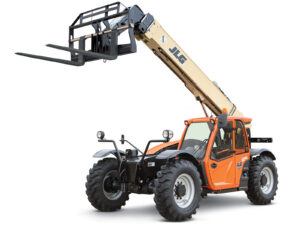
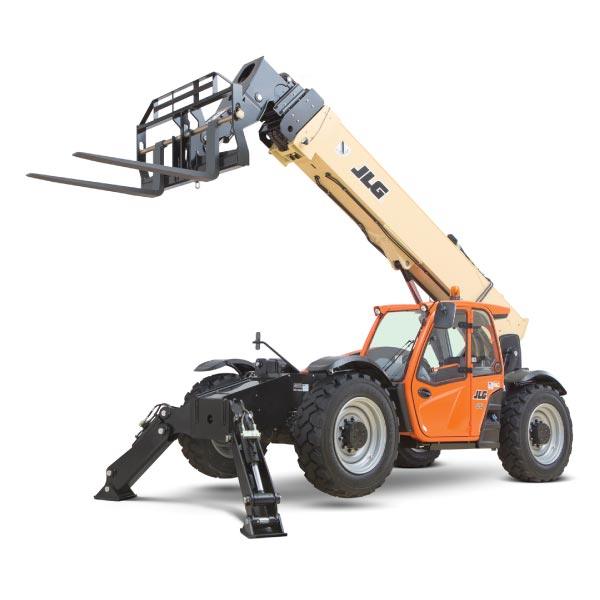
To understand what telehandlers are, start with the basic design. A telehandler, short for telescopic handler, is a lifting machine equipped with a boom that extends forward and upward. Unlike a standard forklift, which lifts vertically on a mast, a telehandler uses a telescoping boom to place materials at height or at extended reach.
Most telehandlers operate with four-wheel drive and are built for rough terrain. The operator controls boom extension, lift angle, and attachment movement from a cab designed for visibility and stability. Telehandlers come standard with pallet forks and can be equipped with a swing carriage for side-to-side fork movement, as well as truss jibs, approved work platforms, and buckets to handle a wide range of jobsite tasks.
The combination of lift height and lift capacity, forward reach, and off-road capability is what separates telehandlers from standard material handling equipment.
How Do Telehandlers Compare To Forklifts And Loaders?
Many contractors evaluating what are telehandlers are really trying to understand how they differ from forklifts or loaders. The difference comes down to reach, stability, and terrain capability.
A traditional forklift works well on flat, stable surfaces inside warehouses or paved yards. It struggles on uneven ground, mud, or gravel. A wheel loader can move bulk material efficiently but does not provide safe elevated placement for structural components or palletized materials. In addition, when equipped with an approved man basket, a telehandler allows crews to work at heights in areas where a conventional manlift may not be able to operate, which is a significant advantage on uneven or restricted terrain job sites.
Telehandlers bridge that gap. They can lift loads vertically like a forklift but also extend forward to place materials onto upper floors, over obstacles, or deep into framed structures. On construction sites, that extended reach reduces the need for cranes in certain phases of a project. On farms, it eliminates the need to reposition multiple machines for feed handling or storage loading and can often be far more versatile than a skid steer for lifting, stacking, and reaching elevated areas.
This flexibility is why telehandlers often replace two or three separate machines on a job site.
Why Are Telehandlers Essential On Construction Sites?
On residential and commercial construction projects, telehandlers support nearly every phase of the build. From framing and truss placement to moving pallets of block or drywall, they keep crews supplied without interrupting workflow. When equipped with an approved man basket, telehandlers also allow crews to be lifted safely to heights and positions where a conventional manlift may not be able to operate, particularly on uneven terrain or in areas with limited access.
A 7,000 to 12,000 pound capacity telehandler can safely lift bundles of lumber, roofing materials, and mechanical equipment, and crews in an approved man basket to upper levels. The extended boom reduces manual handling, minimizes the need for temporary hoisting solutions, and can potentially reduce the need for a manlift for heights under 45 feet. For projects that require more lifting capability than a skid steer can provide but still demand a compact footprint, a 5,000 pound telehandler offers an efficient and highly maneuverable solution for tight or confined job sites.
Telehandlers also improve jobsite safety. Instead of workers manually moving heavy materials or using improvised lifting methods, loads can be placed precisely at height. Reduced manual handling decreases strain injuries and speeds up installation.
For mid-size and longer-term projects in Southern Alberta, a telehandler becomes a central piece of equipment that supports multiple trades simultaneously.
How Do Agricultural Operations Benefit From Telehandlers?
Agricultural and agri-industrial facilities rely heavily on telehandlers for daily operations. When considering what telehandlers are used for in agriculture, the list is extensive.
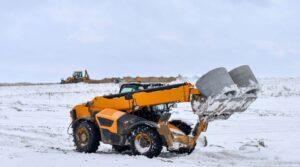
They are commonly used to move large seed totes, stack feed, load manure spreaders, position irrigation equipment, and handle bulk materials. In feedlots and processing facilities, telehandlers provide the reach needed to access tall storage structures safely.
Unlike standard tractors or loaders, telehandlers provide superior lift height and forward reach. This allows operators to load trucks, stack bales, and service elevated equipment without constant repositioning.
For farms managing seasonal workload spikes, renting a telehandler provides flexibility without the capital expense of ownership.
What Lift Capacity And Reach Should You Consider?
Lift capacity and reach are the two most important specifications when selecting a telehandler. Capacity ratings typically range from 5,000 to 12,000 pounds, while lift heights can exceed 40 feet depending on the model.
When determining the correct size, operators should evaluate the maximum load weight, required lift height, and forward reach needed to clear obstacles. Lift charts should always be reviewed to confirm safe operating limits at various boom angles.
Oversizing increases transport costs and fuel consumption. Undersizing limits productivity and creates safety concerns. Matching capacity and reach to job demands ensures efficient operation.
Why Does Versatility Reduce Equipment Costs?
One of the main reasons telehandlers are essential is their ability to reduce the need for multiple machines. With the right attachment package, a telehandler can perform tasks that would otherwise require a forklift, crane, loader, and in many cases a manlift for work below 45 feet.
Telehandlers come standard with pallet forks for material handling and can be equipped with a swing carriage for side-to-side fork movement, as well as truss jibs and approved man baskets for elevated work.
By consolidating tasks into one machine, job sites reduce congestion, improve coordination, and lower overall rental and fuel costs. This versatility directly supports tighter project timelines and controlled budgets.
For contractors and agricultural operators asking what are telehandlers, the answer is straightforward. They are one of the most versatile lifting and material handling machines available for rough terrain job sites. Their combination of lift capacity, reach, and adaptability makes them essential for construction builds, farm operations, and industrial maintenance work.
Telehandlers reduce equipment overlap, improve safety, and increase productivity when properly matched to the job.
For dependable telehandler rentals backed by real construction and agricultural experience across Southern Alberta, contact Mountain View Equipment Rentals to request a quote.